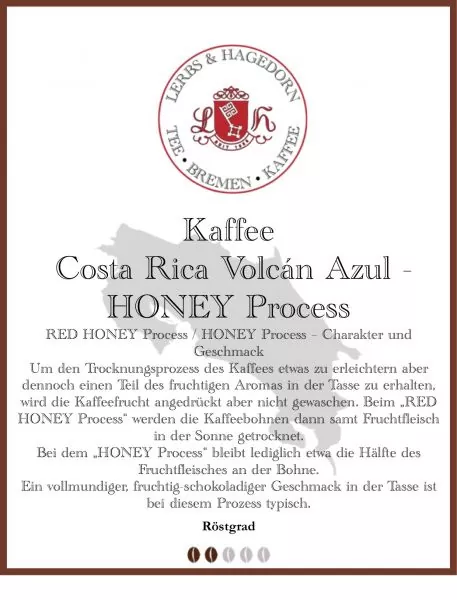
Costa Rica Volcán Azul - HONEY Process coffee in the picture

Customers who bought this product bought also the following products:

Ecuador Galapagos coffee in the picture
Origin and plantationThe Galapagos Islands, famous for their flora and fauna, are located about 1,000 km off the Pacific coast of South America and have belonged to Ecuador since the end of the last century. As early as 1879, the first coffee was grown on Chatham Island using plants imported from French colonies. Excellent coffee is still produced on this island. Today, this island is called San Cristobal and still produces excellent coffee. Due to the Humboldt Current, the south side of the island has a temperate tropical climate. The unique tropical climate, tempered by the Humboldt Current, brings abundant rainfall to the south side of the island from January to May. This climate, combined with the relatively young and nutrient-rich volcanic soil, creates ideal conditions for the growth of coffee plants. To maintain these optimal living conditions, the use of pesticides, fungicides, herbicides and chemical fertilisers is prohibited by the government in the Galapagos.Character and tasteA full-bodied and rounded flavour combined with its fresh aroma and pleasant digestible acidity is perfectly rounded off by its delicate, chocolaty note. The taste lasts long and is in no way inferior to the world-famous Caribbean coffee.
65,23 EUR
65,23 EUR per 1kg
Nicaragua Maragogype Superior Giants coffee in the illustration
This Maragogype comes from the region of Jinotega, where it is grown and harvested on small ficas in the Vilcanese soil at an altitude of over 1,500 metres. It matures at an altitude of 1,500 metres on volcanic soil and is harvested and processed on small fincas. Nicaragua has long been an insider's tip among connoisseurs for high-quality coffee. The coffee cherries are harvested by hand in up to eight passes. In the mountainous regions, only the ripe coffee cherries are harvested by hand in up to eight passes. Because blossoming, unripe and ripe cherries all hang from the same coffee bush, this time-consuming process is repeated several times. This is necessary because not all cherries are ripe at the same time, but rather flowers, green and already ripe cherries can hang on a coffee bush. The Maragogype trees are less productive than conventional coffee plants; in some coffee-growing regions, their cultivation is therefore neglected or abandoned altogether. The largest part of the state consists of a depression that runs through the entire country and is an earthquake zone in its southwestern part, a fault zone of volcanic origin. A chain of volcanoes, some of which are still slightly active, stretches from the great lakes in the south-east of the country to the Gulf of Fonseca, on the border with Guatemala.Character and tasteIn our search for ever better coffee qualities, we found this Nicaraguan Maragogype. Due to the fascinating, evenly sized bean, we chose the Nicaragua Maragogype over the Mexican elephant bean. In the cup, too, this coffee is far ahead of the Mexico Maragogype. Nicaraguan coffee is spicy and almost creamy and finds its way into the cups of Japanese and American coffee lovers. But this coffee is also very popular with coffee connoisseurs here.
41,92 EUR
41,92 EUR per 1kg
Boquete Panamá "Volcán Barú" Coffee in illustration Coffee in the presentation
Origin and plantationIn the highlands of Panama, in the western province of Chiriqui, lies the quiet and beautiful town of Boquete, at the foot of the Barú volcano, with about 14,000 inhabitants. The region is called the "Valley of Flowers and Eternal Spring". Arabica beans are grown under ideal conditions on small plantations here, not far from the border with Costa Rica. Due to the constant wind from the north, the coffee plantations thrive particularly well at an altitude of about 1,500 m and grow extremely slowly. Panama has a share of about 0.2% of the world's coffee production, but belongs to the top of the speciality producers.Character and tasteThanks to its complex and aromatic character, this coffee belongs to the top for connoisseurs. The light to medium body harmonises with the balanced acidity of the taste. The medium roast allows light floral to soft-chocolate notes to unfold, providing a long-lasting aftertaste. Be sure to try this coffee without milk and sugar! Let yourself be surprised and inspired by this small origin.
41,95 EUR
41,95 EUR per 1kg
Ethiopia Sidamo "Dream of Africa" coffee in the presentation
Origin and plantationOur Sidamo growing region is located in the south of the country, on the edge of the Ethiopian highlands. Here, as in the other Ethiopian regions, coffee is grown in smallholder structures. Other well-known coffee regions in Ethiopia include Harar, one of the highest coffee-growing areas in the world. Ethiopia – the former Abyssinia – is considered the cradle of coffee, descendants of the oldest coffee plants have been found in the Ethiopian highlands. Today, the country is the most important Arabica exporter in Africa. Around 12 million of its inhabitants live from coffee cultivation in predominantly smallholder farms.Character and tasteEthiopian coffee is not easy to describe. The "Dream of Africa" offers coffee lovers an impressive variety of flavours. Its distinctly spicy aroma is joined by a chocolaty, heavy richness. A very full body with a slightly floral note gives this coffee its distinct richness.
36,20 EUR
36,20 EUR per 1kg